
What Is RTP in Slots? Return to Player Explained

Andrej Trajkovski Senior Game Writer & iGaming Law Analyst
Andrej Trajkovski is an experienced iGaming writer with a deep-rooted passion for online casinos, slot games, and sports betting. A former slot technician turned full-time writer, Andrej has been in…
- 9 written reviews

Lucas Garner CEO & Editorial Director
Lucas Garner is the founder, CEO, and Editorial Director of PeakyCasino. With more than a decade in online gambling — across operator strategy, affiliate publishing, and editorial leadership — he…
RTP in slots, short for return to player, is the percentage of all money wagered on a slot that the game pays back to players over the long run. A slot with a 96% RTP returns about $96 for every $100 wagered across millions of spins, which leaves a 4% house edge.
RTP is a long-term average, not a promise for your session. This guide explains how RTP is calculated and verified, how it differs from volatility and house edge, what counts as a good RTP, and how to check the version a casino actually runs. For titles at 97% or more, see our high RTP slots page; to learn the basics first, read how to play slots.
Key Takeaways
- RTP is the theoretical share of wagers a slot returns over millions of spins; the house edge is 100% minus the RTP.
- Most online slots publish 94% to 96%. 97% or more is rare, and 99% appears only in a few titles such as Mega Joker (in Supermeter mode) and Book of 99.
- RTP does not decide how often you win. Volatility does, so a high-RTP slot can still have long losing streaks.
- The same slot can ship in several RTP versions, so check the info screen at the casino where you play.
What Is RTP in Slots?
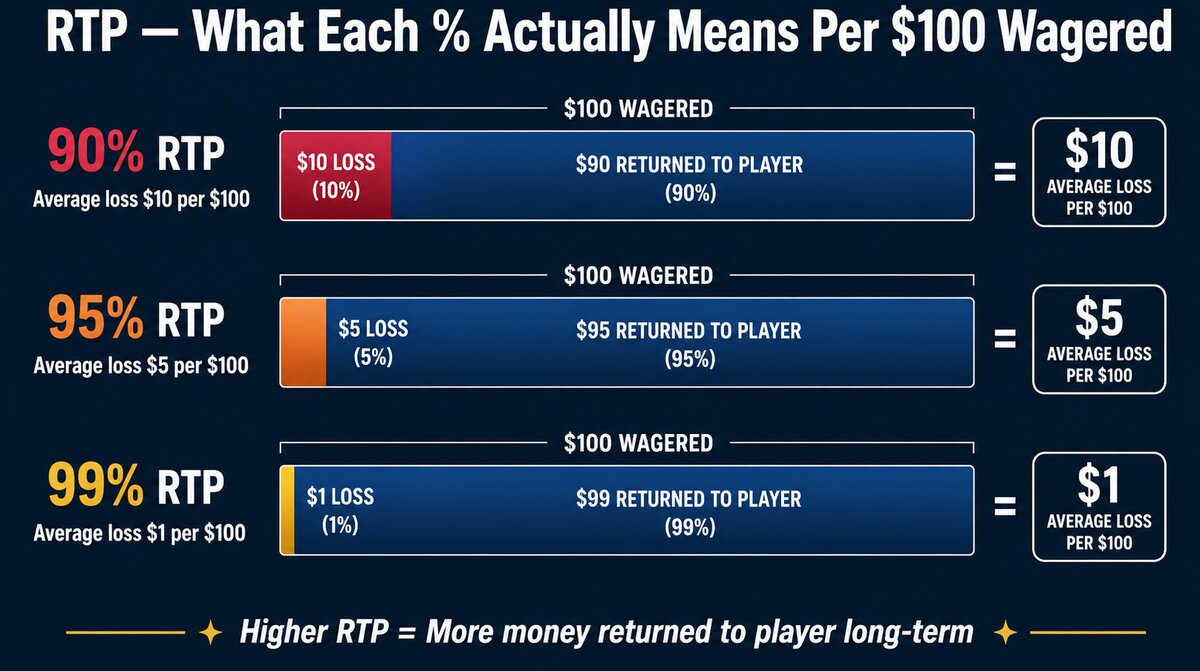
90/95/99% RTP map to $10/$5/$1 loss per $100.
RTP (Return to Player) is the theoretical percentage of total wagered money that a slot machine is programmed to pay back to players over the very long run.
- Concrete example: A 96% RTP means the slot expects to return $96 for each $100 wagered across millions of spins. Individual sessions vary wildly—you might win $500 or lose everything.
- How it’s calculated: Game developers test over millions of simulated spins in controlled environments. Independent labs like eCOGRA verify results before launch.
- RTP benchmarks:
- 96% = Average/Good rtp
- 97-98% = Very Good
- 99% = Exceptional and rare
RTP is theoretical and doesn’t adjust to individual players. One person can lose quickly while another hits a massive win on the same machine—randomness governs short-term results.
Comparison to other casino games: Blackjack with basic strategy offers 98-99%+ RTP. Roulette typically runs 94-97% depending on wheel type. Top online casinos offer many online slots competitive with table game odds.
How Is RTP Different From Volatility?
RTP measures long-term payout percentage. Volatility measures how streaky those results are.
- Volatility defined: Low volatility delivers many smaller wins with consistent payouts. High volatility means fewer but larger wins with longer dry spells between them.
- The combination matters: A slot can have high RTP and still be high volatility. A 97% RTP Megaways game might drain your bankroll for 200 spins before hitting 1,000x. Average RTP with low volatility might feel “safer” despite mathematically inferior returns.
Examples: for more high-variance titles, see our high volatility slots page.
- Blood Suckers: 98% RTP, low-to-medium volatility—steady smaller payouts
- White Rabbit Megaways: 97.72% RTP, high volatility—13,000x max win potential but longer losing streaks
Practical recommendations: Players with smaller bankrolls or short sessions should lean toward high RTP and lower volatility. Thrill-seekers with larger bankrolls may accept slightly lower RTP in exchange for massive payout potential.
For bonus wagering, steady high RTP / low-medium volatility slots make it easier to grind through requirements without busting prematurely.

High volatility = bigger swings, longer dry spells.
How Does RTP Affect Your Results?
RTP affects long-term expectation, while short-term results depend on randomness and volatility.
How small differences compound (1,000 spins at $1 per spin):
- 94% RTP: Expected loss of $60
- 96% RTP: Expected loss of $40
- 98% RTP: Expected loss of $20
- 99% RTP: Expected loss of $10
Higher RTP means lower house edge (100% minus RTP). Your bankroll lasts longer, which proves especially valuable when using bonuses or earning loyalty points.
High RTP slots often deliver more consistent frequent small wins. This psychological benefit helps you enjoy longer sessions, even when big jackpots may be smaller wins or rarer.
Bankroll management guidance: Favor 96%+ RTP for general play. Reserve low rtp progressive jackpots for occasional “lottery-style” shots only—treat them as entertainment spending, not strategy.
Session length, bet size (1-2% of bankroll per spin), and self-imposed limits have more impact on whether you walk away positive or negative than RTP alone.
What Is a Good RTP for a Slot?
A good RTP for an online slot is 96% or higher; 97% or more is high, and 99% is exceptional. The comparison below shows where those figures sit against the market.
- Average RTP baseline: Most modern online slot titles sit around 94-96% RTP, while the best high rtp online slots push into 97-99% territory with a significantly smaller house edge.
- House edge comparison: A 96% rtp slot carries a 4% house edge, meaning for every $100 you bet, the casino expects to keep $4 over time. At 99% RTP, that edge drops to just 1%—a fourfold difference that compounds dramatically over 1,000+ spins.
- Volatility patterns: Many of the highest RTP slots tend toward medium or low volatility, delivering smaller payouts more frequently rather than chasing rare large payouts.
High rtp slots pay more consistently over long sessions. High volatility slots offer bigger but rarer hits. For bonus clearing and extended play, steady high RTP machines outperform jackpot-chasing titles where you might lose your bankroll waiting for a win that never comes.

Mega Joker (NetEnt) tops at 99% RTP.
Which Slots Have the Highest RTP?
The slots below publish some of the highest RTPs available. These are the studios’ published figures; the version at an individual casino can be lower, so always confirm in the game’s info screen.
99% RTP Tier:
- Mega Joker (NetEnt) – Up to 99% RTP when played optimally in supermeter mode. Classic fruit machine with 5-reel setup and 2,000x max win. Requires strategic bet transfers to reach elite RTP; casual play drops it significantly.
- Book of 99 (Relax Gaming) – Fixed 99% RTP in many markets. Mythology-themed book slot with expanding symbols during free spins and medium volatility. Some casinos deploy 96-97% versions—always verify in-game.
98%+ RTP Tier:
- Blood Suckers (NetEnt) – 98% RTP with low volatility. Vampire theme, pick-and-win bonus rounds, frequent free spins, and 1,014x max win. Ideal for bonus clearing.
- Marching Legions – 98.12% RTP. Roman legions theme with high volatility for players wanting bigger swings.
- Codex of Fortune – 98% RTP. Fantasy theme with solid mechanics.
- Mighty Black Knight – 98% RTP. Medieval adventure with strong bonus features.
- Money Cart 2 (Relax Gaming) – 98% RTP. High-volatility bonus-respin format with multipliers building to 5,000x potential.
97%+ RTP Tier:
- Ultra Stack Feature Rose – 97.93% RTP. Classic slot design with the Ultra Stack Feature for stacked wild symbols.
- Starmania – 97.86% RTP. Low-medium volatility space theme for relaxed sessions.
- White Rabbit Megaways (Big Time Gaming) – 97.72% RTP. High volatility with up to 248,832 ways to win and 13,000x max win. Wonderland theme with retriggerable free spins.
- Medusa Megaways – 97.63% RTP. High volatility mythology slot with Megaways mechanics.
- Texas Tea – 97.35% RTP. Low volatility oil tycoon theme—steady and reliable.
- Secrets of Atlantis – 97.07% RTP. Underwater theme with solid mechanics.
Note: Many online slots like Mega Joker show different RTP depending on bet level or mode. “Up to 99%” often requires optimal play or specific settings.
For our full 97%+ list, the studios behind it and the RTPs of the slots we have reviewed, see high RTP slots.
Are 99% RTP Slots Real?
Yes, 99% RTP slots exist, but they are rare and often come with conditions.
- Verified 99%-range examples: Mega Joker (up to 99% in supermeter mode) and Book of 99 (fixed 99% in many markets) are real, playable titles.
- Availability varies: Not every online casino carries these titles. Even when available, some operators offer high rtp slots with different RTP presets (94%, 96%, 99%) depending on jurisdiction.
- Optimal play requirements: Some “up to 99%” claims rely on specific stake levels or perfect strategy. Casual players might experience lower practical RTP without realizing it.
Don’t expect entire lobbies filled with 99% slots. Realistically, your high-RTP options will fall in the 96-98% window at most online casinos.
Chasing only ultra-high RTP titles can limit variety and enjoyment. Consider a mixed approach—strong RTP for serious play, favorite themes for entertainment.
How to Check a Slot’s RTP at an Online Casino
RTP information is usually published, but not always obvious. Here’s exactly where to look.
- Check in-game: Click the “i” info icon, question mark, or menu to open paytable/help screens. The rtp rate is typically listed there—sometimes requiring scrolling.
- Casino lobby features: Some regulated top online casinos provide full RTP lists or allow filtering by RTP range (96%+) in their lobby or help center.
- Cross-reference sources: Check the game developer’s official site or independent review portals when the casino doesn’t display RTP clearly.
- Watch for RTP variants: In certain jurisdictions, casinos choose from multiple configurations for the same game (94%, 96%, 99%). Always verify the exact setting at your chosen site rather than assuming the highest.
- Physical slot machines: RTP is rarely posted on land-based cabinets. State gaming reports sometimes publish this data. Generally, online versions offer high rtp slots pay rates significantly above Vegas floor machines (which often run 88-95%).
How Does RTP Affect Bonus Wagering?
RTP matters most when you clear a bonus, because wagering requirements make you bet the bonus many times over. The higher the RTP, the less you lose on average during playthrough.
Typical bonus types for slots:
- Deposit matches (100% up to a specified amount)
- Free spins bundles (500–1,500 spins on selected titles)
- Loss-back offers refunding a percentage of net losses
How wagering requirements interact with RTP: High RTP slots help you clear wagering with less expected loss. On a 98% rtp rate game, you lose roughly 2% of money wagered during playthrough. On a 94% game, that jumps to 6%—tripling your expected loss.
Example calculation: Clearing a $100 bonus with 35x wagering ($3,500 total bets):
- On 99 rtp slot: Expected loss of $35
- On 94% RTP slot: Expected loss of $210
Always check whether specific slot machines are eligible for bonuses. Some high rtp or progressive jackpot games might be excluded or contribute less toward playthrough requirements.
Pros and Cons of High RTP Slots
No slot is perfect. High RTP machines have clear advantages and trade-offs.
Pros:
- Better long-term odds with slower bankroll drain
- More frequent smaller wins extending session time
- Stronger value when clearing bonuses or earning loyalty points
- Lower expected loss per spin compared to average slot games
Cons:
- Genuinely top-tier RTP titles (97-99%) are limited in availability
- Some online casinos may not offer high rtp slots at all
- Many ultra-high RTP designs feature simpler graphics or fewer cinematic bonus features
- High RTP doesn’t guarantee wins—you can still lose quickly on a bad run
High RTP doesn’t remove risk from winning real money attempts. Responsible gambling practices and limits remain essential regardless of RTP choice.
Balance your approach: prioritize high RTP for serious bankroll management while occasionally mixing in lower-RTP favorites for variety and entertainment value.
Who Checks That a Slot’s RTP Is Real?
In properly regulated jurisdictions—licensed US states like West Virginia, parts of Canada, UK Gambling Commission areas, and EU markets—high RTP slots are tested and audited for fairness.
- Certified RNG: Licensed casinos must use certified Random Number Generators. Independent labs audit game configurations before launch.
- No secret rtp change: Operators cannot arbitrarily change RTP mid-session. Any rtp change requires deploying a different approved game configuration and often regulatory approval.
- Online vs. land-based: Online slots in regulated markets often have higher RTP than physical slot machines in tourist casinos due to lower overhead and stricter transparency rules.
Only play slots at licensed, regulated sites where published RTP figures are audited and consumer protections exist—age verification, self-exclusion options, and dispute processes.
Age and responsibility: Real-money play is restricted to adults (18+ or 21+ depending on region). Use deposit limits and self-exclusion tools if needed.
Offshore licences, such as those from Curaçao or Anjouan, involve lighter oversight than the UK Gambling Commission or the Malta Gaming Authority. At those casinos, the game studio’s own certification is the main protection, so stick to recognized providers and check the info screen.
Where to Play Slots With Published RTPs
Choose a casino that shows RTP in each game’s info screen and carries studios that publish their figures. Our real money online slots page compares the casinos we have reviewed by slot library, providers and licence, and our best payout casinos page ranks operators by overall payout rate. For the odds behind each spin, read slot machine odds.
Responsible Gambling and RTP
Even the highest RTP slots remain games of chance designed for entertainment—not guaranteed profit engines.
- Set limits first: Establish clear budgets and time limits before you play. Treat deposited money as the cost of entertainment, not an investment.
- Understanding rtp reduces false expectations: Knowing the math helps, but doesn’t prevent losses. Even a 99 rtp slot can produce long losing streaks where you lose more than expected.
- Warning signs: Chasing losses, hiding play from others, borrowing to gamble—these indicate problem gambling. Seek help immediately if you recognize these behaviors.
- Resources: National helplines, counseling services, and self-exclusion registries exist in most regulated jurisdictions. Most players benefit from RTP education, with studies showing it reduces chase behavior.
Combining knowledge of RTP with strict personal limits is the best way to keep slot play enjoyable and safe in the long run.

Mobile slots match desktop RTP — same RNG seed.