Craps Strategy and Odds: Best Bets, House Edge and Systems

Jamie Smith Sport and Casino Writer, Editor, Blogger, Podcaster
Jamie Smith is Senior Feature Writer at PeakyCasino, covering casino reviews, live dealer products, sports betting crossover, and regulatory developments. With more than a decade in iGaming and sports media,…
- 6 written reviews
The best craps strategy is to bet the Pass Line or Don’t Pass, back it with the largest Odds bet your budget allows, and avoid the center of the table. No system removes the house edge, but this approach keeps it near 1% or lower.
This guide covers the odds behind every main craps bet, the beginner and intermediate strategies players use, the popular systems and their risks, and how to plan a bankroll. If you are new to the rules, start with our guide on how to play craps.
What Is the Quickest Safe Craps Strategy?
Bet the table minimum on the Pass Line, add full Odds once a point is set, and skip every other bet. This plan keeps the house edge at 1.41% or lower on every dollar you risk.
Use it as your Day-1 plan:
- Bet the minimum on the Pass Line before the come-out roll.
- When a point is set (4, 5, 6, 8, 9 or 10), add the maximum Odds you can afford behind it.
- Add one Come bet with Odds only once you are comfortable.
- Skip proposition bets, Hardways and anything in the center of the table.
- Stop when you reach your session win or loss limit.
Why This Plan Works
It puts most of your money on the Odds bet, which has no house edge, and only the minimum on the line bet, which does. Center bets cost 9% to 16.67%.
The difference adds up. On $10,000 of resolved bets, a 1.41% edge has an expected loss of about $141. A 10% edge has an expected loss of about $1,000.
Example at a Hypothetical $15 Table
Assume a table that allows 3-4-5x Odds: 3x on 4 and 10, 4x on 5 and 9, 5x on 6 and 8. These limits are common but not universal, so check the table before you play.
You bet $15 on the Pass Line and the point is 6. You add $75 Odds (5 x $15). If the 6 repeats before a 7:
- Pass Line pays $15 at even money.
- Odds pay $90 at 6:5.
- Total profit: $105 on $90 at risk.
The casino’s edge applies only to the $15 line bet. The $75 Odds bet is paid at true odds. If a 7 comes first, you lose all $90, which is why bet size still matters.
What Are the Odds in Craps?
Craps odds come from the 36 possible combinations of two dice. A 7 can be rolled six ways, more than any other total, so it is the most likely roll at 16.67%, and every payout is built around it.
| Total | Ways (of 36) | Chance per roll | True odds against |
|---|---|---|---|
| 2 or 12 | 1 each | 2.78% | 35:1 |
| 3 or 11 | 2 each | 5.56% | 17:1 |
| 4 or 10 | 3 each | 8.33% | 11:1 |
| 5 or 9 | 4 each | 11.11% | 8:1 |
| 6 or 8 | 5 each | 13.89% | 6.2:1 |
| 7 | 6 | 16.67% | 5:1 |
For bets that wait for a number or a 7, only those two outcomes count. A point of 4 can be made three ways and a 7 six ways, so the true odds of making a 4 before a 7 are 2:1.
| Point | Ways to make point | Ways to roll 7 | Chance to make point | True odds |
|---|---|---|---|---|
| 4 or 10 | 3 | 6 | 33.3% | 2:1 |
| 5 or 9 | 4 | 6 | 40.0% | 3:2 |
| 6 or 8 | 5 | 6 | 45.5% | 6:5 |
Overall, a Pass Line bet wins 49.29% of the time. The gap between that and 50% is the 1.41% house edge.
What Is the House Edge on Every Craps Bet?
The house edge ranges from 0% on Odds to 16.67% on Any Seven. Line bets and Place 6 or 8 stay under 1.6%; most center bets cost over 9%. Values below assume common payouts and depend on the table’s rules.
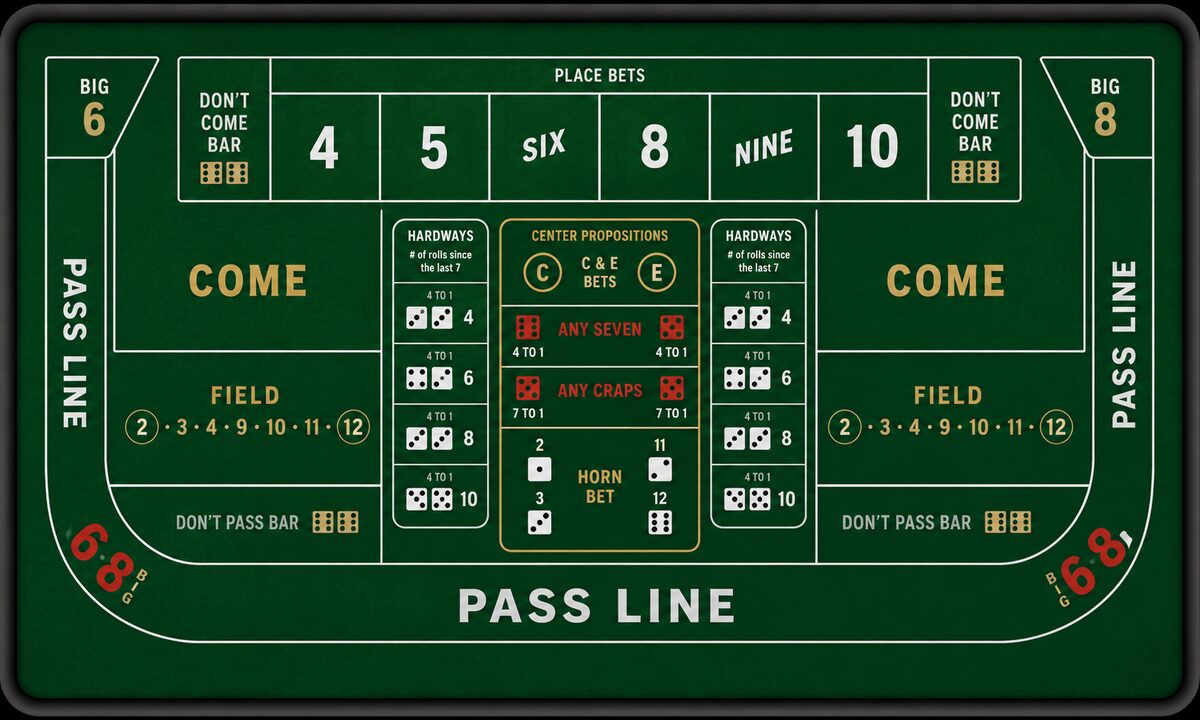
Pass Line covers six numbers; Don’t Pass covers five.
| Bet | Payout | True odds | House edge |
|---|---|---|---|
| Odds behind Pass/Come | 2:1, 3:2, 6:5 | Same | 0% |
| Odds behind Don’t Pass/Don’t Come | 1:2, 2:3, 5:6 | Same | 0% |
| Don’t Pass / Don’t Come | 1:1 | — | 1.36% |
| Pass Line / Come | 1:1 | — | 1.41% |
| Place 6 or 8 | 7:6 | 6:5 | 1.52% |
| Buy 4 or 10 (5% commission on win only) | 2:1 less 5% of win | 2:1 | 1.67% |
| Lay 4 or 10 (5% commission on win) | 1:2 less 5% of win | 1:2 | 2.44% |
| Field (12 pays 3:1) | 1:1, 2:1, 3:1 | — | 2.78% |
| Place 5 or 9 | 7:5 | 3:2 | 4.00% |
| Buy 4 or 10 (5% commission paid up front) | 2:1 | 2:1 | 4.76% |
| Field (2 and 12 pay 2:1) | 1:1, 2:1 | — | 5.56% |
| Place 4 or 10 | 9:5 | 2:1 | 6.67% |
| Big 6 / Big 8 | 1:1 | 6:5 | 9.09% |
| Hard 6 / Hard 8 | 9:1 | 10:1 | 9.09% |
| Hard 4 / Hard 10 | 7:1 | 8:1 | 11.11% |
| Any Craps (2, 3, 12) | 7:1 | 8:1 | 11.11% |
| Yo (11) / Ace-Deuce (3) | 15:1 | 17:1 | 11.11% |
| Aces (2) / Twelve (12) | 30:1 | 35:1 | 13.89% |
| Any Seven | 4:1 | 5:1 | 16.67% |
Commission rules differ by casino. Some charge the 5% on Buy bets only when you win; others charge it when you place the bet. Online, the game’s help screen lists the payouts in use.
How Much Do Odds Bets Lower the Edge?
Odds bets lower the combined house edge on your line bet plus Odds. The more Odds you take, the closer the total gets to 0%.
| Odds allowed | Pass Line + Odds | Don’t Pass + Odds |
|---|---|---|
| No Odds | 1.41% | 1.36% |
| 1x | 0.85% | 0.68% |
| 2x | 0.61% | 0.46% |
| 3-4-5x | 0.37% | 0.27% |
| 10x | 0.18% | 0.12% |
The edge per dollar falls, but the dollars at risk rise. A 10x Odds bet on a $10 line bet puts $110 on one point. Take Odds only up to what your bankroll can absorb.
Why Can Odds Bets Have No House Edge?
Casinos offer Odds bets because they can only be made on top of a line bet, which does carry an edge. The casino profits from the line bet and accepts a break-even bet alongside it.
That is why experienced players treat the line bet as the entry fee and the Odds bet as the main wager.
Which Beginner Craps Strategies Work Best?
Three simple strategies keep the house edge under 1.6%: Pass Line plus Odds, a three-number Come strategy, and Place 6 and 8. They differ in how much action they give you, not in long-term results.
Give any method several shooters before judging it. Craps swings hard in the short run, and a few rolls say nothing about whether a strategy is sound.
Pass Line Plus Odds
Bet the minimum on the Pass Line each come-out and take maximum Odds on every point. This is the lowest-cost way to play with the shooter.
- Bet the table minimum on the Pass Line every come-out roll.
- Add maximum Odds when a point is set.
- Collect wins and decide whether to keep or press.
- After a seven-out, bet the minimum again for the next shooter.
For a $10 table, a buy-in of $400 to $600 (40 to 60 base bets) covers normal losing runs. Keep the line bet at the minimum when shooters seven-out quickly. Recent results do not change the next roll.
Three-Number Come Strategy
Add up to two Come bets after the point is set, each backed with Odds, so three numbers are working. The house edge stays the same as Pass Line plus Odds, with more frequent small wins.
At a hypothetical $10 table with 3x Odds:
- Pass Line point 5: $10 + $30 Odds = $40 at risk.
- Come bet moves to 6: $10 + $30 Odds = $40 at risk.
- Come bet moves to 8: $10 + $30 Odds = $40 at risk.
Total exposure is $120. Rolls of 5, 6 or 8 (14 of 36 combinations) each pay one bet, but a single 7 loses all three. Stop at three numbers so one seven-out does not wipe out the session.
Players often call this the 3-Point Molly. The name covers many small variations, all built on the same structure.
Place 6 and 8
Place bets on 6 and 8 win when that number rolls before a 7, pay 7:6 and carry a 1.52% edge. They are the best bets on the table outside line bets and Odds.
Place 6 and Place 8 each pay 7:6 — best non-odds bets.
Bet in multiples of $6 so the 7:6 payout works. A $12 bet on each number pays $14 per hit. Many players combine Pass Line plus Odds with Place 6 and 8 for steady action on the two most frequent point numbers.
Place bets can be taken down at any time. Some players remove them after two hits to lock in a small profit. That changes how a session feels, not its expected cost.
Which Intermediate Craps Strategies Do Players Use?
Intermediate strategies change how you raise and lower bets, not the odds. They need a larger bankroll and closer tracking, and some raise your house edge.
Practice them on low-stakes online tables before using them at a busy live table, where mistakes slow the game and cost money.
Growing the Odds Bet Instead of the Line Bet
When you want bigger action, raise the Odds bet and keep the line bet at the minimum. Only the line bet carries an edge, so this adds risk without adding cost per dollar.
| Session phase | Line bet | Odds bet | Total at risk |
|---|---|---|---|
| Start | $10 | $10 | $20 |
| After +2 units | $10 | $30 | $40 |
| After +4 units | $10 | $50 | $60 |
| After a losing run | $10 | $10 | $20 |
Raise Odds only after a net profit, never while you are down for the session, and reset after a losing streak.
Don’t Side (Dark Side) Strategy
The dark side version uses Don’t Pass and Don’t Come with laid Odds. It has the lowest edges in craps, 1.36% before Odds, but you risk more to win less on each Odds bet.
- Don’t Pass, then lay Odds against the point.
- Add up to two Don’t Come bets, each with laid Odds.
- Collect all three when the shooter sevens out.
Laying Odds on a point of 4 means risking $20 to win $10. You win more often, but each loss is larger. At a crowded live table you will win when most players lose; online, nobody sees which side you bet.
The Iron Cross
The Iron Cross combines a Field bet with Place bets on 5, 6 and 8, so every total except 7 pays something. It wins often but costs more than line bets, because the Field and Place 5 carry 5.56% and 4.00% edges.
A typical setup: $10 Field, $10 Place 5, $12 Place 6, $12 Place 8, for $44 at risk.
| Roll | Result | Net |
|---|---|---|
| 2 | Field pays 2:1 | +$20 |
| 3, 4, 9, 10, 11 | Field pays 1:1 | +$10 |
| 12 | Field pays 2:1 or 3:1 | +$20 or +$30 |
| 5, 6 or 8 | Place bet pays $14, Field loses $10 | +$4 |
| 7 | Everything loses | -$44 |
It wins on 30 of 36 rolls, yet one 7 costs $44 while most wins pay $4 to $10. If you use it, take bets down after a fixed number of hits and never add to it after a 7.
Do Craps Betting Systems Work?
No betting system can turn craps into a winning game. Martingale, ladder betting, the Iron Cross and hedging systems change when you win or lose, not how much you lose on average.
Why Martingale Fails
Martingale means doubling your bet after every loss to recover it with one win. It produces many small wins and occasional very large losses, and table maximums or your bankroll stop it before it recovers.
| Bet number | Bet | Total risked | Profit if this bet wins |
|---|---|---|---|
| 1 | $10 | $10 | $10 |
| 2 | $20 | $30 | $10 |
| 3 | $40 | $70 | $10 |
| 4 | $80 | $150 | $10 |
| 5 | $160 | $310 | $10 |
| 6 | $320 | $630 | $10 |
Six losses in a row put $630 at risk to win $10. Even-money craps bets lose about 50.7% of the time, so long losing runs happen regularly over a few hundred bets. When they do, the system’s losses wipe out many sessions of small wins.
What Good Craps Strategy Actually Means
A good craps strategy is a set of rules you follow, not a way to beat the game. It should keep your average cost low and your losses predictable.
- Choose bets with a house edge under 2%.
- Take Odds within your budget.
- Size bets to your bankroll.
- Set win and loss limits before you start.
- Stop when you reach either limit.
Memory is selective. Players remember the hot roll that turned $100 into $400 and forget the sessions lost to quick seven-outs. Over time, the house edge applies to all of them.
Which Craps Bets Should You Avoid?
Avoid one-roll proposition bets, Hardways and Big 6 or Big 8. Each costs between 9% and 16.67% of every bet, six to twelve times the Pass Line edge, and none has a better version you cannot get elsewhere on the layout.
Proposition Bets in the Center
Proposition bets are wagers in the center of the table, most of them settled by the next roll. Their payouts look large, but they pay less than true odds by a wide margin.
| Bet | What it covers | Typical payout | House edge |
|---|---|---|---|
| Any Seven | Next roll is 7 | 4:1 | 16.67% |
| Aces or Twelve | Next roll is 2 (or 12) | 30:1 | 13.89% |
| World (Whirl) | 2, 3, 7, 11 and 12 in one bet | Varies by number; 7 pushes | 13.33% |
| Horn | 2, 3, 11 and 12 in one bet | Varies by number | 12.50% |
| Hop bet, hard (e.g., 3-3) | One exact pair on the next roll | 30:1 | 13.89% |
| Hop bet, easy (e.g., 4-2) | One exact non-pair on the next roll | 15:1 | 11.11% |
| Any Craps | Next roll is 2, 3 or 12 | 7:1 | 11.11% |
Payouts on Horn, World and Hop bets differ more between casinos than on other bets. Check the paytable before you make one.
Hardways
A Hardway bet wins if 4, 6, 8 or 10 rolls as a pair before a 7 or the same total rolled any other way. Hard 6 and 8 cost 9.09%; Hard 4 and 10 cost 11.11%.
Players often add Hardways for fun or as dealer tips. Treat them as entertainment spending, not part of a strategy.
Big 6 and Big 8
Big 6 and Big 8 win when 6 or 8 rolls before a 7, the same as Place 6 and 8, but pay only even money. That raises the edge from 1.52% to 9.09% for the same result.
If you want action on 6 or 8, place them in $6 units instead.
How Should You Adapt Craps Strategy for Online Play?
Online, use the same low-edge bets but lower your bet size, because RNG games run faster. Also check bonus terms, because many casino bonuses exclude craps or count it at a reduced rate.
Pace and Bet Size
An RNG craps game rolls as fast as you click. More rolls per hour multiply the hourly cost of the same house edge.
Set a roll or time budget as well as a money budget. Use the demo mode, where offered, to practice a strategy without risking money.
Bonuses and Craps
Many casino welcome bonuses exclude craps or give it a low wagering contribution. In our reviews as of November 2026, Bovada’s welcome matches, including the first-deposit bonus, and SlotsandCasino’s welcome package all list craps as excluded.
Playing craps while a bonus is active can void the bonus or the winnings. Read the eligible games before you opt in, or play with cash only.
Live Dealer Craps
Live dealer craps uses real dice and a fixed betting window. It is slower than RNG craps, which lowers the hourly cost, but minimum bets are usually higher.
How Should You Manage a Craps Bankroll?
Bring 40 to 60 times the table minimum for one session, and set a loss limit you will not cross. Craps can swing through several base bets in a few rolls, so a short bankroll ends sessions early.
Stack chips by denomination — track session bankroll easily.
| Style | Bankroll multiple | $10 table | $15 table | $25 table |
|---|---|---|---|---|
| Conservative (Pass + Odds) | 40x | $400 | $600 | $1,000 |
| Moderate (three-number Come) | 50x | $500 | $750 | $1,250 |
| Aggressive (pressing bets) | 60x or more | $600+ | $900+ | $1,500+ |
These are planning guidelines, not guarantees. A sample plan for a $10 table:
- Buy-in: $600.
- Win goal: +$150, then consider leaving.
- Loss limit: -$200, then stop.
- Exposure cap per shooter: about $50.
- Breaks: 5 to 10 minutes every hour.
Practical Money Rules at the Table
Small rules applied every roll protect your bankroll more than any system. Keep them simple enough to follow under pressure.
- Set aside half of any win larger than two units.
- Press a number once or twice, then collect.
- Keep winnings separate from your starting stack, online or at the rail.
- Keep bets at 4 to 5 base units until a shooter has made a point or two, if you prefer to limit early exposure.
- Never raise bets to chase losses.
- Stop when you are tired, angry or drinking.
Online casinos offer deposit limits, loss limits, cooling-off periods and self-exclusion. Our bankroll management guide explains how to use them with a session plan.
Does Strategy Change Between Live and Online Craps?
No. The math is the same whether real dice or an RNG decide the roll. What changes is pace, minimum bets and how easily you can follow a plan.
| Factor | Live casino table | Online RNG craps | Bubble craps machine |
|---|---|---|---|
| Social pressure | High | None | Low |
| Minimum bets | Usually highest | Usually lowest | Usually low |
| Pace | Set by the table | Set by you | Set by the machine |
| Odds limits | Posted at the table | In the help screen | Often capped; check the help screen |
A faster pace means more bets per hour and a higher hourly cost at the same edge. Lower your bet size on fast games.
Live Table Etiquette
At a land-based table, a few rules keep the game moving and avoid disputes.
- Handle the dice with one hand only.
- Throw the dice so they hit the back wall.
- Buy in between rolls, not while the dice are out.
- Place your own Pass Line bet; dealers handle Odds and Place bets.
- Keep hands and drinks off the layout while dice are moving.
New side bets appear on some layouts, both live and online. Read their payouts first; most carry edges far above line bets.
Related Craps Guides
Continue with the page that fits your next step:
- How to play craps: table layout, come-out roll and point, and an example round.
- Bubble craps rules and strategy: the dome machine version and its limits.
- Bankroll management: session budgets and bet sizing.
Ready to play? Compare table formats, limits and craps-friendly bonus terms on our list of online craps casinos.
Craps has a built-in house edge, so every session has an expected cost. Set a deposit and time limit before you play, never chase losses, and use the tools in our responsible gambling guide. In the US, call 1-800-MY-RESET for free, confidential help.