Double Deck Blackjack Strategy: Rules, Odds and Best Plays

Jamie Smith Sport and Casino Writer, Editor, Blogger, Podcaster
Jamie Smith is Senior Feature Writer at PeakyCasino, covering casino reviews, live dealer products, sports betting crossover, and regulatory developments. With more than a decade in iGaming and sports media,…
- 6 written reviews
Double deck blackjack strategy is basic strategy adjusted for a game dealt from two 52-card decks. With 3:2 blackjack and double after split allowed, correct play leaves a house edge of roughly 0.2% to 0.4%, lower at tables where the dealer stands on soft 17.
This guide explains how double deck differs from six- and eight-deck games, which rules decide the house edge, the plays that change from the standard chart and why card counting matters less online than many articles suggest.
What Is Double Deck Blackjack?
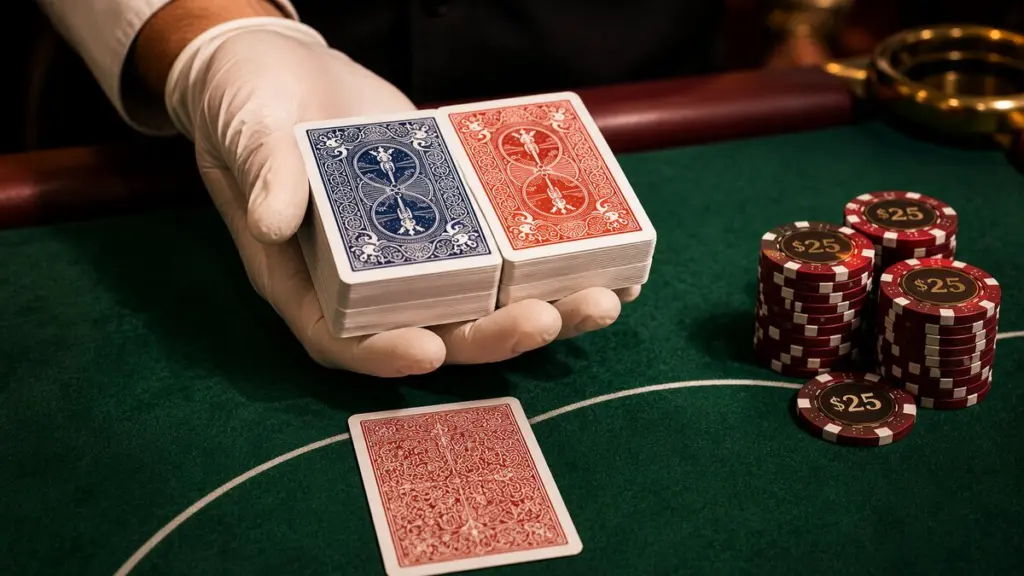
Double deck blackjack is dealt from two standard decks shuffled together, 104 cards in total. The rules of play are the same as in shoe games, but fewer decks shift the odds slightly in the player’s favor.
With fewer cards, each card dealt changes the remaining mix more. Removing two 10s from 104 cards matters more than removing them from 312. This is why the best plays for doubling and splitting differ a little from multi-deck charts.
How Does Double Deck Compare to Other Formats?
Fewer decks mean slightly better odds for the player, as long as the payout and other rules stay the same. Casinos often offset that with tighter rules on single and double deck tables.
| Format | Cards | Effect of deck count alone (approx.) | Common catch |
|---|---|---|---|
| Single deck | 52 | About 0.5% better than eight decks | Often 6:5 payouts or no double after split |
| Double deck | 104 | About 0.2% better than six decks | Some tables hit soft 17 |
| Six deck | 312 | Baseline | Most common online format |
| Eight deck | 416 | Slightly worse than six decks | Common at live tables |
A double deck game that pays 6:5 is worse than a six-deck game that pays 3:2. Always compare the full rule set, not the deck count.
Which Rules Decide the House Edge in Double Deck?
The blackjack payout matters most, followed by the soft 17 rule and double after split. A 6:5 payout adds about 1.4% to the house edge and wipes out the benefit of using two decks.
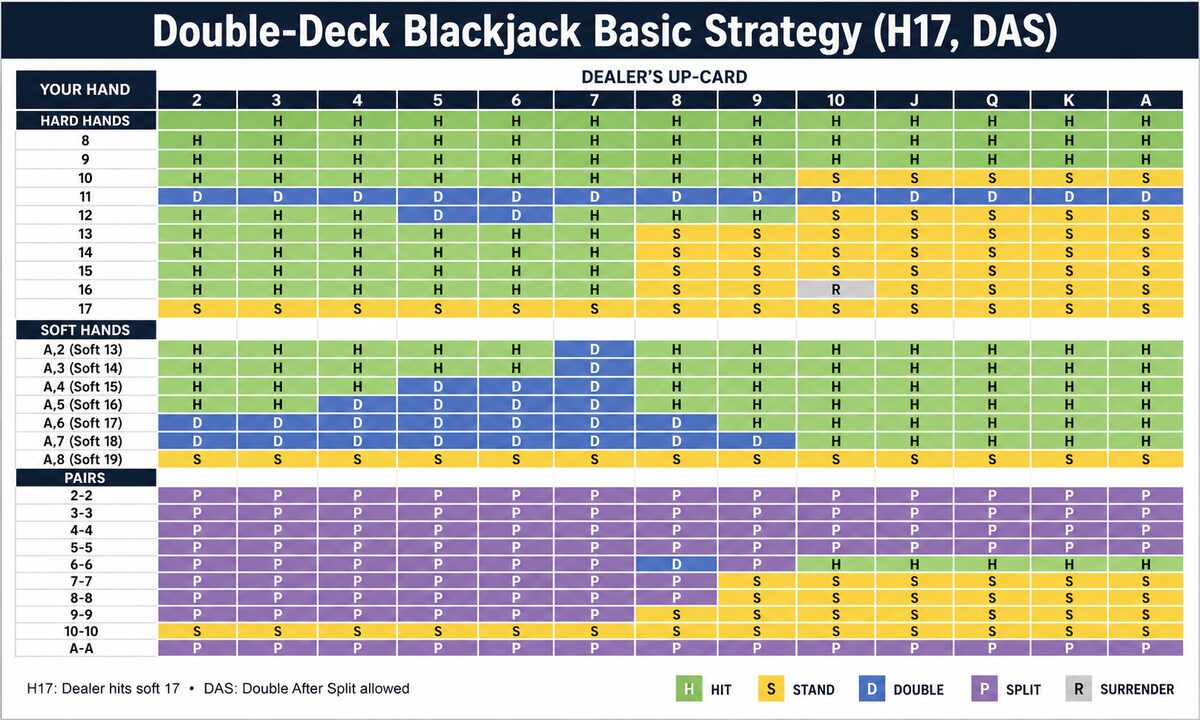
Double-deck H17 DAS edge sits near 0.30%.
| Rule change | House edge impact (approx.) |
|---|---|
| Blackjack pays 6:5 instead of 3:2 | +1.4% |
| Dealer hits soft 17 (H17) instead of standing (S17) | +0.2% |
| No double after split | +0.1% to +0.15% |
| No re-splitting of aces | +0.08% |
| Late surrender not offered | +0.08% |
With 3:2 blackjack, double after split and late surrender, basic strategy can bring the house edge near 0.2% when the dealer stands on soft 17. With H17, it sits nearer 0.3% to 0.4%. With 6:5 blackjack and restricted doubling, it climbs well above 1.5%. All values are approximate and depend on the exact rules.
What Is the Correct Basic Strategy for Double Deck Blackjack?
Most double deck decisions match the standard multi-deck chart. A handful of plays change, mostly more doubling and splitting, because the dealer’s and your remaining cards carry more weight with only two decks.
Start with the full chart in our blackjack strategy guide, then apply these double deck changes (dealer stands on soft 17, double after split allowed):
| Hand | Dealer upcard | Multi-deck play | Double deck play |
|---|---|---|---|
| Hard 9 | 2 | Hit | Double |
| Hard 11 | Ace | Hit | Double |
| Pair of 6s | 7 | Hit | Split |
If the dealer hits soft 17, also double soft 18 (A,7) against a 2 and soft 19 (A,8) against a 6, and hit soft 18 against an ace. Check which rule your table uses before you sit down.
Which Doubling and Splitting Plays Matter Most?
Hard 9, 10 and 11 and the soft hands are where most of your edge-saving decisions happen. Getting these right matters more than any side rule.
- Hard 9: double against 2 through 6; otherwise hit.
- Hard 10: double against 2 through 9; hit against 10 or ace.
- Hard 11: double against every upcard.
- Soft 17 (A,6): double against 3 through 6; otherwise hit. Never stand on it.
- Soft 18 (A,7): double against 3 through 6 (stand if you cannot double), stand against 2, 7, 8 and ace, and hit against 9 and 10.
- Soft 19 and soft 20: stand.
Pair splitting follows a clear pattern:
- Always split aces and 8s.
- Never split 10s or 5s; play 5,5 as a hard 10.
- Split 2s, 3s and 6s against 2 through 7 when double after split is allowed.
- Split 9s against 2 through 6 and 8 or 9; stand against 7, 10 or ace.
Should You Take Insurance or Side Bets?
No. Insurance carries a house edge of about 6.8% in a double deck game, and most side bets cost several percent or more per hand.
Insurance pays 2:1 if the dealer’s hole card is a 10-value card. With two decks, 32 of the 103 unseen cards are 10s when the dealer shows an ace, so the bet loses about 6.8% of its value over time (before counting your own cards). Side bets like pairs or poker-hand bets add entertainment, not value.
Does Card Counting Work in Double Deck Blackjack?
Card counting is more effective with two decks than with six in a physical game. It is not useful at online RNG tables, which reshuffle every hand, and live dealer shoes rarely leave enough cards to matter.
Counting systems such as Hi-Lo give low cards (2 to 6) a value of +1, 7 to 9 a value of 0 and 10s and aces a value of −1. A high running count, divided by the decks left, suggests the remaining cards favor the player. Because only two decks are in play, the count swings faster than in a six-deck shoe.
In practice, the benefit depends on how deep the dealer deals before shuffling, and land-based casinos may limit or bar players they suspect of counting. Online, RNG games use a fresh shuffle every round, so there is nothing to count. We explain counting so you can judge claims about it, not as a way to make money.
Where Can You Play Double Deck Blackjack Online?
Many online casinos offer an RNG double deck table among their blackjack games. Rules vary by software provider, so check the payout, soft 17 rule and doubling rules in the game’s info panel.
Look for 3:2 blackjack, dealer stands on soft 17 and double after split. If the only double deck game pays 6:5, a six-deck 3:2 table is the better choice. Compare reviewed casinos, their table rules and bonus terms on our list of online blackjack casinos.
What Are the Most Common Double Deck Mistakes?
The three costly mistakes are using the wrong chart, picking a table with poor rules and betting too large for your bankroll.
Using a Single Deck or Multi-Deck Chart
Charts for other deck counts give slightly wrong answers on borderline hands such as hard 9 against 2 and hard 11 against an ace. Use a double deck chart for the rule set at your table, and check it when unsure instead of guessing.
Choosing a Table With Poor Rules
A 6:5 payout, H17 and no double after split together erase the benefit of two decks. Before your first hand, confirm 3:2 blackjack, the soft 17 rule, double after split and surrender in the rules panel.
Betting Too Much for Your Bankroll
Even with basic strategy, losing runs of 8 to 10 hands happen. Keep your base bet a small fraction of your session budget and set a loss limit before you start. Our bankroll management guide explains unit sizing.
Blackjack has a built-in house edge, so every session has an expected cost. Set a deposit and time limit before you play, never chase losses, and use the tools in our responsible gambling guide. In the US, call 1-800-MY-RESET for free, confidential help.
Related Blackjack Guides
- Online blackjack casinos: where to play and which rules to look for.
- Blackjack strategy: how to play, the full basic strategy chart and odds.
- Blackjack card values: hand totals, aces and soft hands.
- What is a push in blackjack: ties and bet returns.