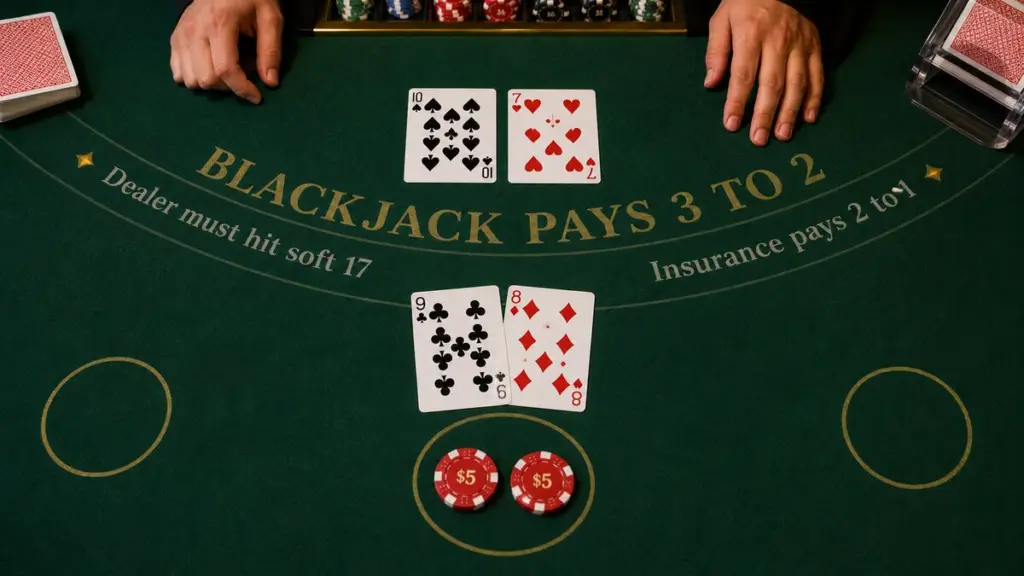
What Is a Push in Blackjack? Ties, Payouts and Odds

Andrej Trajkovski Senior Game Writer & iGaming Law Analyst
Andrej Trajkovski is an experienced iGaming writer with a deep-rooted passion for online casinos, slot games, and sports betting. A former slot technician turned full-time writer, Andrej has been in…
- 9 written reviews

Lucas Garner CEO & Editorial Director
Lucas Garner is the founder, CEO, and Editorial Director of PeakyCasino. With more than a decade in online gambling — across operator strategy, affiliate publishing, and editorial leadership — he…
A push in blackjack is a tie: you and the dealer finish with the same total, and your bet is returned without a win or a loss. Under standard rules, about 8.5% of hands end in a push, roughly 1 hand in 12.
This guide explains when a push happens, how tied naturals and special rules like “dealer 22 pushes” work, how often ties occur and how pushes differ from insurance, side bets and even money.
How Does a Push Work in Blackjack?
A push happens when neither side busts and both hands end on the same total. The dealer leaves your bet in place or returns it, and the round is over for that hand.
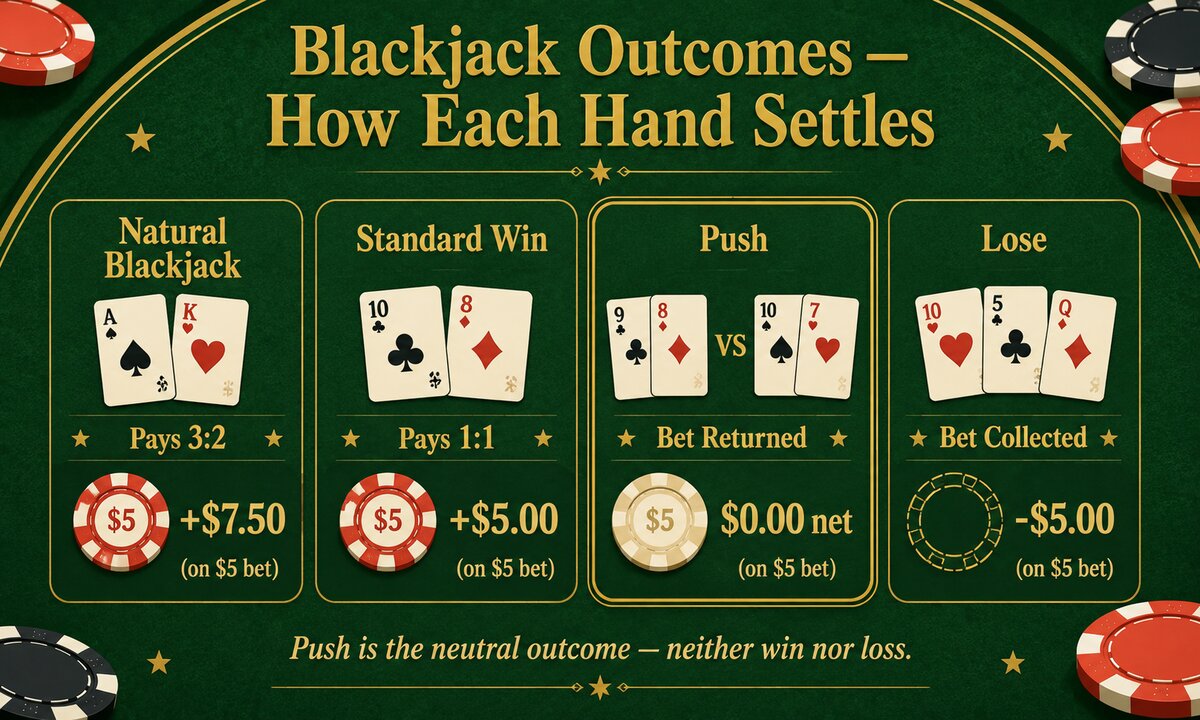
Push sits between win and loss — neutral net result.
For example, you stand on 19 and the dealer draws to 19. Neither hand beats the other, so the result is a push. You do not need to do anything; the bet stays yours for the next round or can be taken back.
Push Compared With Other Outcomes
A push sits between a win and a loss. It returns exactly your bet and nothing more.
| Outcome | What happens to a $10 bet |
|---|---|
| Natural blackjack (3:2 table) | You win $15 and keep your $10 |
| Regular win | You win $10 and keep your $10 |
| Push | You keep your $10; no profit |
| Loss or bust | You lose the $10 |
A bust is never a push. If you go over 21, you lose immediately, even if the dealer also busts later in the round.
When Do Pushes Happen?
Most pushes happen when both hands finish on 17, 18, 19 or 20. A tie on natural blackjacks is much rarer but follows the same rule: equal hands push.
Most pushes happen on 17s, 18s, 19s, or 20s.
Tied Natural Blackjacks
If you and the dealer both have a natural blackjack (an ace plus a 10-value card as the first two cards), the hand is a push. You get your bet back instead of the usual 3:2 payout.
At hole-card tables, the dealer checks for blackjack when showing an ace or a 10-value card. If both sides have a natural, the hand ends at once as a push. Both sides holding a natural happens in roughly 0.2% of hands, about 1 in 440.
A natural also beats a dealer 21 made with three or more cards. That is a win at the blackjack payout, not a push. For more on how two-card 21s are counted, see our guide to blackjack card values.
Ties on Standard Totals
Ties on 17 to 20 make up nearly all pushes. The dealer must draw until reaching at least 17, so dealer totals cluster in that range, and so do the totals players stand on.
A tie on 20 is especially common because two 10-value cards make 20 and 10-value cards are 4 in every 13 cards. The dealer’s soft 17 rule also shifts the mix: a dealer who hits soft 17 ends on 17 less often and draws to other totals.
Special Push Rules in Some Variants
Some variants make the dealer’s 22 a push instead of a dealer bust. In Blackjack Switch and Free Bet Blackjack, when the dealer busts with exactly 22, every player hand still in play pushes instead of winning.
That rule takes back a large share of the hands you would normally win from dealer busts. These games pay for their extra features, such as switching cards or free doubles, through it. Read the game’s rules and published return before you play, because the rule changes the correct strategy too.
How Often Does a Push Happen?
About 8.5% of hands push in a standard multi-deck game with basic strategy, close to 1 in 12. Wins and losses make up the rest, at roughly 42% and 49%.
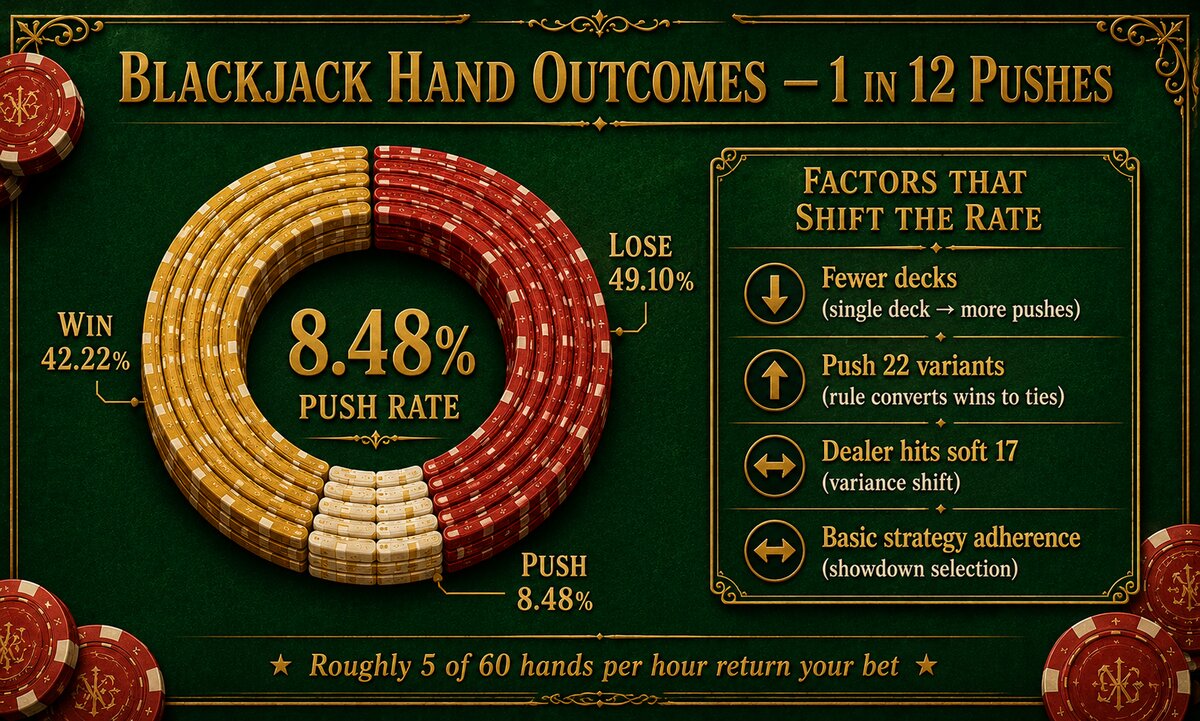
Pushes occur about 1 in every 12 blackjack hands.
| Result | Approximate share of hands |
|---|---|
| Player wins | 42.4% |
| Dealer wins | 49.1% |
| Push | 8.5% |
These are long-run averages for common rules (dealer stands on soft 17, blackjack pays 3:2). Your own push rate in a session will vary. Push rates also shift with:
- Dealer soft 17 rule: hitting soft 17 changes how often the dealer ends on each total.
- Game variant: dealer-22-pushes rules turn some wins into ties.
- Your strategy: hands you bust or surrender never reach a tie.
Players lose more hands than they win, yet the house edge with basic strategy is only around 0.5%. The gap closes because doubles, splits and 3:2 naturals pay more when you win. The full numbers are in our blackjack strategy guide.
How Do Pushes Affect Your Bankroll?
A push has zero effect on your balance, so it does not change the house edge or your expected result. It only means fewer hands settle as a win or a loss.
If you play 60 hands per hour, about 5 will push and about 55 will move your balance. That helps when setting a realistic session length and loss limit.
Pushes also stretch betting progressions. A system that changes your bet after each win or loss has to decide what to do after a tie, and no choice changes the math. The Martingale, for example, still risks a very large bet after a losing streak. Our bankroll management guide covers flat betting and session limits.
What Do Players Often Get Wrong About Pushes?
The common mix-ups involve insurance, side bets and even money. Each is a separate decision from the main hand and settles by its own rules.
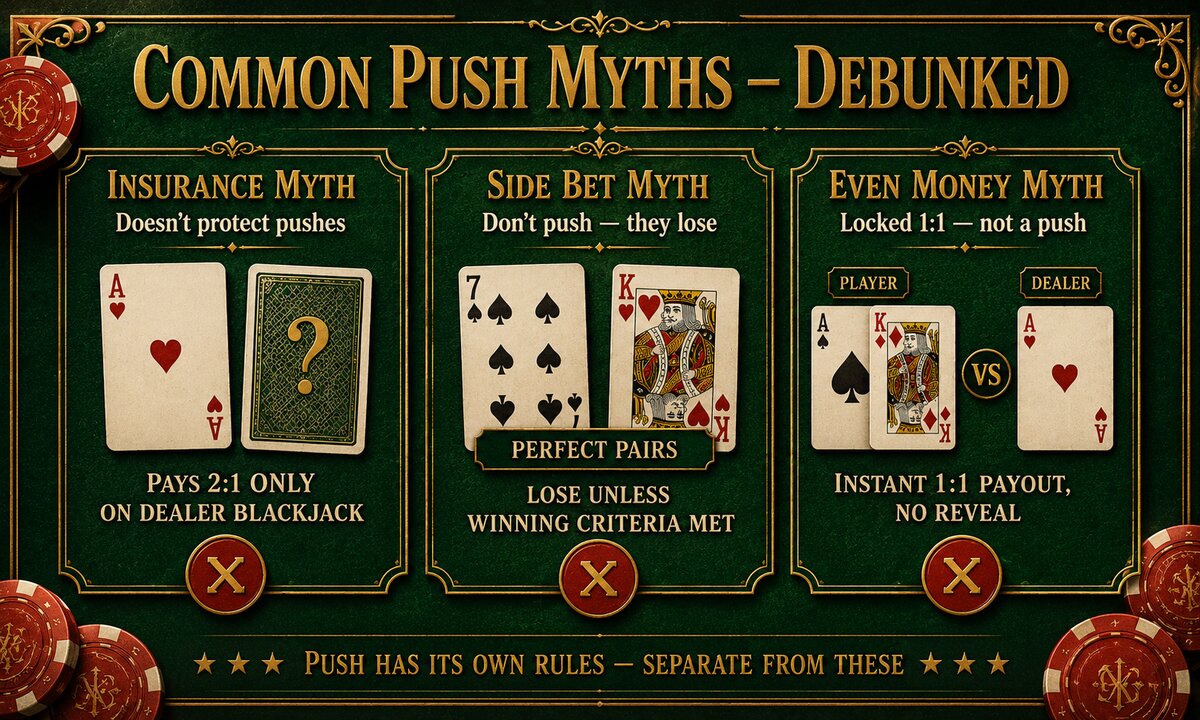
Insurance pays 2:1 only on dealer’s natural blackjack.
Insurance Does Not Protect Against a Push
Insurance is a side bet that the dealer has a natural blackjack when showing an ace. It pays 2:1 if the dealer has blackjack and loses otherwise, whatever happens to your main hand.
Insurance does not protect a 19 or a 20 against a tie or a loss. It costs about 7.4% of the bet over time in a six-deck game, so basic strategy declines it.
Side Bets Do Not Push With the Main Hand
Most side bets lose unless their own winning condition is met. If you bet on a pair and do not receive one, that bet loses even if your main hand pushes or wins.
Even Money Versus a Tied Natural
Even money is an offer to pay your natural blackjack at 1:1 right away when the dealer shows an ace. Taking it avoids a possible push, but it is the same bet as insurance in another form.
If you decline, the dealer will usually not have blackjack, and you receive the full 3:2 payout. Over many hands, declining returns more than taking even money. The choice to accept is a preference for certainty, not the better bet.
Where Can You Play Blackjack Online?
Online blackjack is available at RNG and live dealer tables, and push rules are the same at both when the rules match. Check the game’s info panel for special rules such as dealer 22 pushes.
Compare casinos, table rules and bonus terms on our list of online blackjack casinos, all reviewed by our team.
Blackjack has a built-in house edge, so every session has an expected cost. Set a deposit and time limit before you play, never chase losses, and use the tools in our responsible gambling guide. In the US, call 1-800-MY-RESET for free, confidential help.
Related Blackjack Guides
- Online blackjack casinos: where to play and which table rules to look for.
- Blackjack strategy: how to play, the basic strategy chart and odds.
- Blackjack card values: hand totals, aces and soft hands.
- Double deck blackjack strategy: rules and plays for two-deck games.