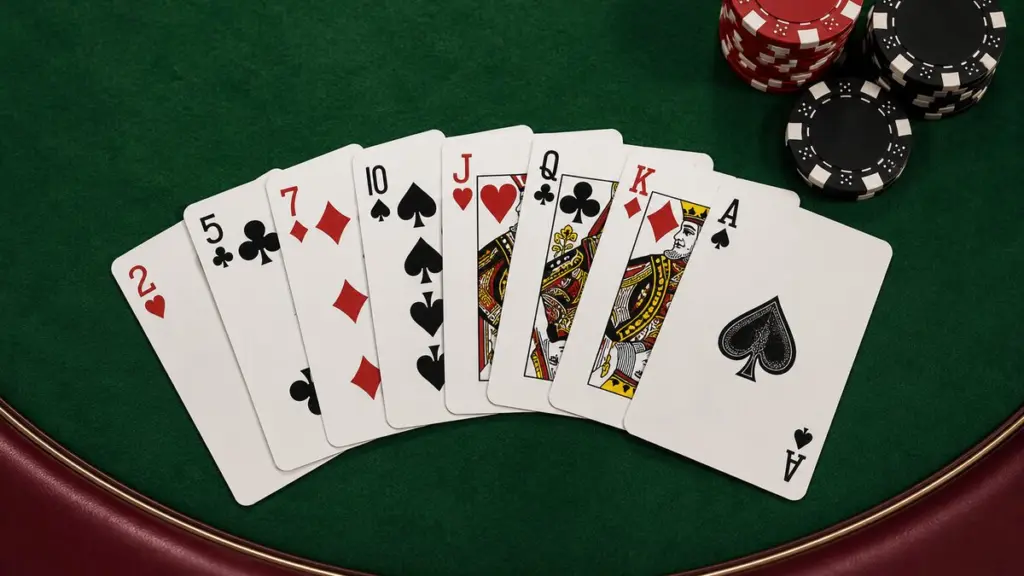
Blackjack Card Values: Aces, Face Cards and Hand Totals

Andrej Trajkovski Senior Game Writer & iGaming Law Analyst
Andrej Trajkovski is an experienced iGaming writer with a deep-rooted passion for online casinos, slot games, and sports betting. A former slot technician turned full-time writer, Andrej has been in…
- 9 written reviews
In blackjack, number cards 2 to 10 are worth their face value, jacks, queens and kings are worth 10, and an ace is worth 1 or 11, whichever helps your hand without going over 21. Suits never matter.
This guide shows how to value every card, add up any hand (including hands with several aces), tell soft hands from hard hands and spot the special totals that decide payouts. Card counting and strategy charts are covered in separate guides linked below.
What Is Each Card Worth in Blackjack?
Each card has one fixed value except the ace. Cards 2 to 10 count as printed, every face card counts as 10 and the ace counts as 1 or 11.
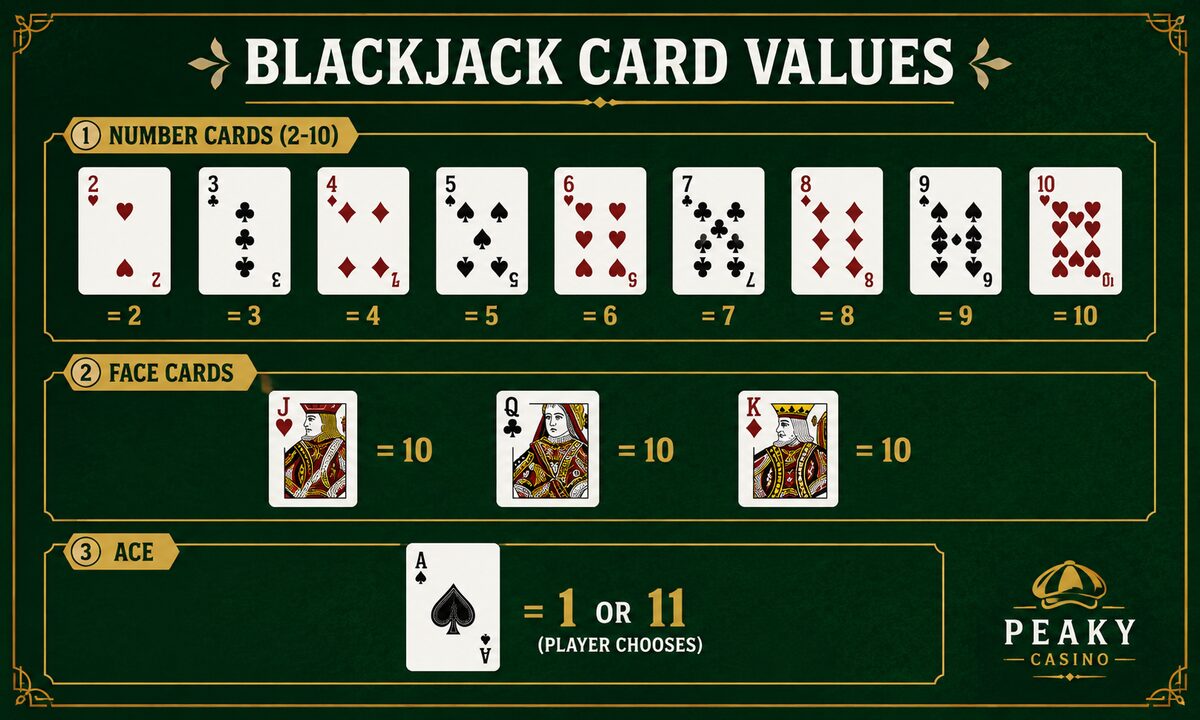
Aces can be 1 or 11 — player picks each turn.
| Card | Point value |
|---|---|
| 2 to 9 | Face value |
| 10 | 10 |
| Jack | 10 |
| Queen | 10 |
| King | 10 |
| Ace | 1 or 11 |
The goal of blackjack is to finish closer to 21 than the dealer without exceeding 21. Every decision at the table starts with an accurate total.
Number Cards (2 to 10)
Number cards always count at their printed value. A 2 of hearts is 2 points, a 7 of spades is 7 points and a 10 of clubs is 10 points.
Suit has no effect on value. A 5 and an 8 dealt face up give you 13, whatever their suits.
Face Cards (Jack, Queen, King)
Every face card is worth 10 points, exactly like a printed 10. A jack and a king together total 20.
This makes 10-value cards the most common value in the deck. Each 52-card deck holds 16 of them: four 10s, four jacks, four queens and four kings. That is 4 in every 13 cards, which shapes hitting, doubling and how often a natural blackjack appears.
Aces (1 or 11)
An ace counts as 11 unless that would take your hand over 21, in which case it counts as 1. The switch happens automatically; you never declare it.
This flexibility makes the ace the most valuable card in blackjack. It creates soft hands, explained below, and it is half of every natural blackjack.
How Do You Calculate a Blackjack Hand Total?
Add the values of all your cards, counting one ace as 11 if the total stays at 21 or below; otherwise count every ace as 1. That single rule handles every hand.
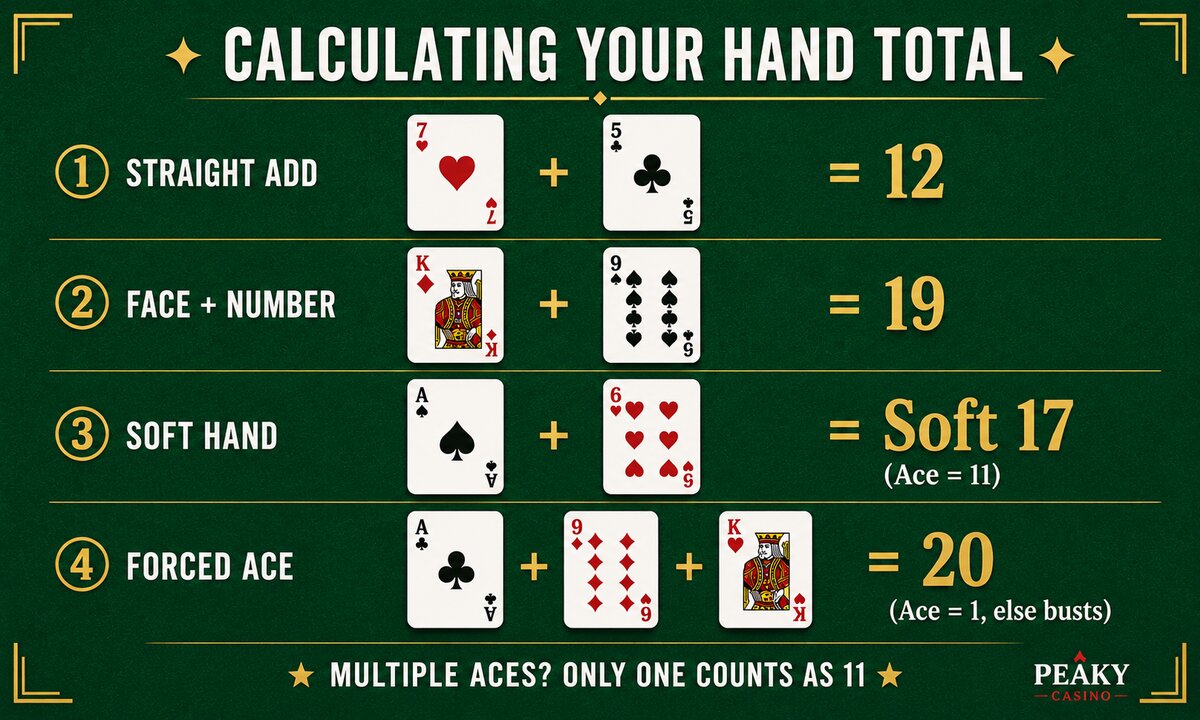
Multiple aces? Only one counts as 11.
Basic Addition Method
Follow three steps for any hand:
- Add number cards at face value.
- Count each jack, queen and king as 10.
- Count one ace as 11 if the total stays at 21 or below; otherwise count it as 1.
Examples:
- 7 + 5 = 12.
- King + 9 = 19.
- Ace + 6 = soft 17 (11 + 6).
- Ace + 9 + King = hard 20 (11 + 9 + 10 = 30 would bust, so the ace is 1).
How Do Multiple Aces Count?
Only one ace in a hand can count as 11. Two aces as 11 would make 22, so every extra ace counts as 1.
- A + A = soft 12 (11 + 1).
- A + A + 8 = soft 20 (11 + 1 + 8).
- A + A + 9 + 3 = hard 14 (1 + 1 + 9 + 3, because 11 + 1 + 9 + 3 = 24).
This matters most after you split aces. Each new hand starts with one ace, and most tables give you only one more card on each.
Common Hand Examples
The same total can be soft or hard. The difference is whether an ace can still count as 11.
| Cards | Calculation | Total | Hand type |
|---|---|---|---|
| K + 7 | 10 + 7 | 17 | Hard |
| 5 + 3 + 2 | 5 + 3 + 2 | 10 | Hard |
| A + 7 | 11 + 7 | 18 | Soft |
| A + 6 + 10 | 1 + 6 + 10 | 17 | Hard |
| A + 2 + 4 | 11 + 2 + 4 | 17 | Soft |
| Q + J | 10 + 10 | 20 | Hard |
What Is the Difference Between Soft and Hard Hands?
A soft hand contains an ace counted as 11; a hard hand has no ace or only aces counted as 1. Soft hands cannot bust with one more card, so they are played more aggressively.
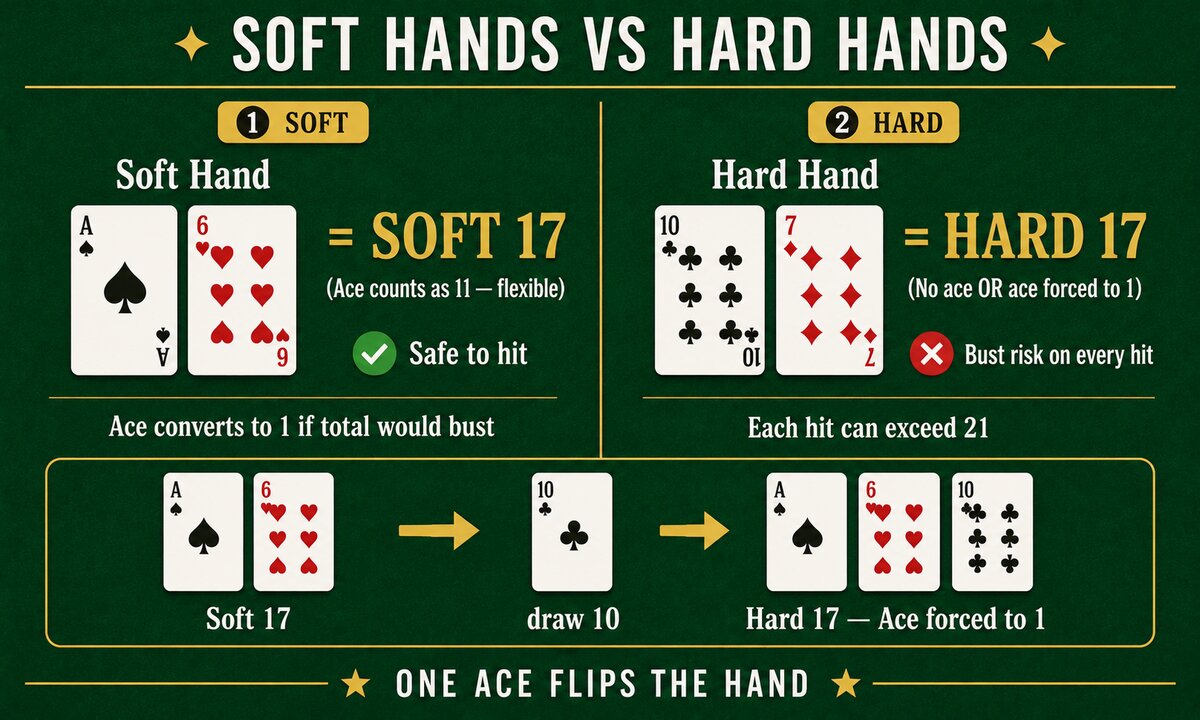
One ace flips the hand from soft to hard.
Soft Hands
A soft hand stays flexible because the ace can drop from 11 to 1 if you draw a high card. Taking one more card can never bust it.
- A + 6 = soft 17.
- A + 2 + 4 = soft 17.
- A + 7 = soft 18.
- A + 5 + 2 = soft 18.
With soft 17, a 10-value card simply turns the hand into hard 17. That safety net is why basic strategy hits or doubles soft 17 instead of standing.
Hard Hands
A hard hand has no ace that can still count as 11, so a high card can bust it. Every extra card carries real risk.
- 10 + 7 = hard 17.
- A + 6 + 10 = hard 17 (the ace must be 1).
- 8 + 8 + 3 = hard 19.
- A + A + 9 + 3 = hard 14.
A hard 17 busts on any 5 or higher, which is 9 of the 13 card ranks. Only an ace, 2, 3 or 4 keeps it alive, so basic strategy stands on hard 17.
How Soft and Hard Hands Compare
| Factor | Soft hand | Hard hand |
|---|---|---|
| Ace flexibility | Ace can still drop to 1 | No ace, or ace already counted as 1 |
| Bust risk on one hit | None | Rises with the total |
| Doubling | Often correct against a dealer 3 to 6 | Mainly on hard 9, 10 and 11 |
| Example: 17 | Hit or double | Stand |
The dealer’s soft 17 rule follows the same logic. At S17 tables the dealer stands on soft 17; at H17 tables the dealer hits it, which adds about 0.2% to the house edge. Check the rule in the game’s info panel.
Which Special Totals Should You Recognize?
Two totals end a hand at once: a natural blackjack (21 with your first two cards) and a bust (any total over 21). Recognizing both instantly avoids costly misreads.
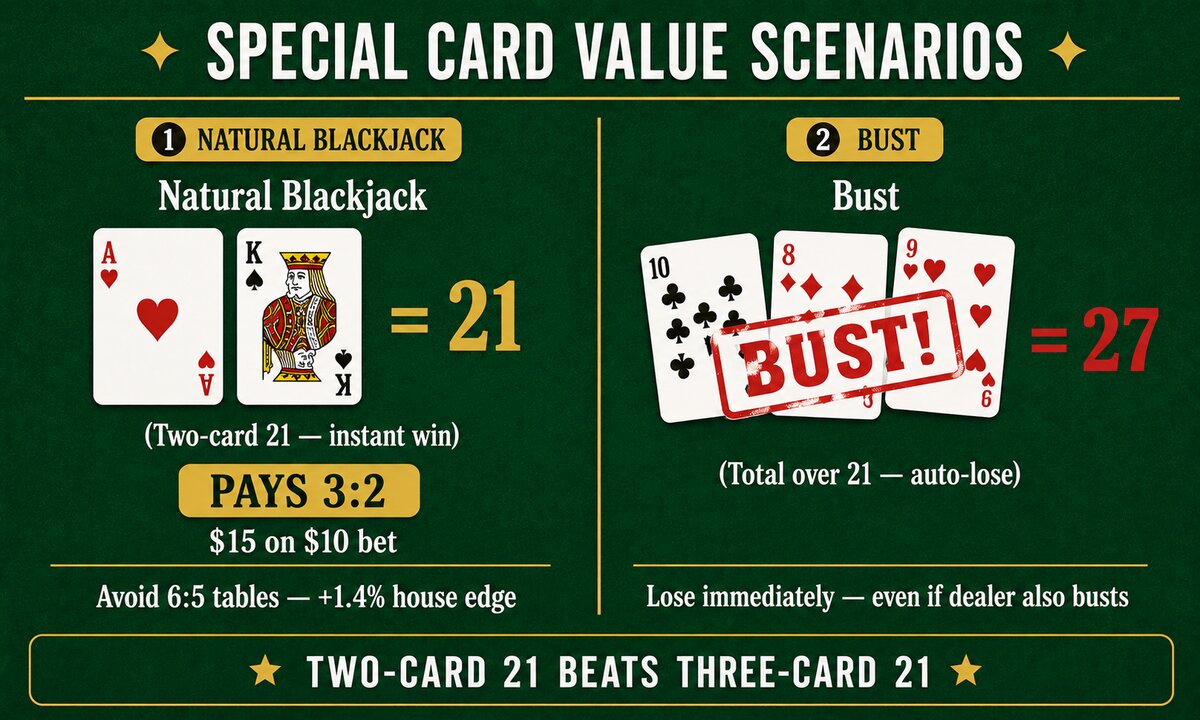
Two-card 21 beats three-card 21 at 3:2.
Natural Blackjack (21 With Two Cards)
A natural blackjack is an ace plus any 10-value card as your first two cards. It beats every other dealer hand, including a 21 made with three or more cards.
- Ace + 10.
- Ace + jack.
- Ace + queen.
- Ace + king.
A natural usually pays 3:2, so a $10 bet wins $15. Some tables pay only 6:5 ($12 on $10), which adds about 1.4% to the house edge. If the dealer also has a natural, the hand is a push and your bet is returned. A 21 made after splitting aces usually counts as 21, not as blackjack.
Busting
You bust when your total exceeds 21, and you lose immediately, even if the dealer busts later in the round. This is the main source of the house edge.
- 10 + 7 + 8 = 25 (bust).
- K + Q + 5 = 25 (bust).
- 5 + 9 + 4 + 6 = 24 (bust).
- A + 6 + 6 + 9 = 22 (bust, even with the ace counted as 1).
In the last example, A + 6 + 6 is already hard 13, not soft 23. The ace dropped to 1 when the second 6 arrived.
What Are the Most Common Card Value Mistakes?
The three common mistakes are miscounting aces, giving face cards the wrong value and confusing soft with hard hands. Each one leads to the wrong hit or stand decision.
Miscounting Ace Values
Start with one ace as 11. If the total goes over 21, recount that ace as 1.
- A + 9 + K: 11 + 9 + 10 = 30, so recount as 1 + 9 + 10 = hard 20.
- A + A + 8: 11 + 1 + 8 = soft 20.
- A + 5 + 7: 11 + 5 + 7 = 23, so recount as 1 + 5 + 7 = hard 13.
Giving Face Cards the Wrong Value
All picture cards equal 10. A jack is not 11 and a queen is not 12. When you see a face card, think “10”.
New players speed up by dealing random two-card hands at home and saying each total out loud.
Confusing Soft and Hard Hands
Ask one question: can an ace in this hand count as 11 without going over 21? If yes, the hand is soft. If no, or if there is no ace, the hand is hard.
For example, A + 7 is soft 18 because 11 + 7 = 18. A + 6 + 10 is hard 17 because 11 + 6 + 10 = 27 would bust.
How Do Card Values Connect to Blackjack Strategy?
Card values tell you your total; basic strategy tells you what to do with it against the dealer’s upcard. Strategy charts list hard totals, soft totals and pairs separately for exactly this reason.
The rules at your table also matter: the number of decks, whether the dealer hits soft 17 and whether surrender is offered all change a few decisions. Our blackjack strategy guide has the full chart and the odds behind it.
Practice with these hands and say whether each is soft or hard:
- 9 + 4 + A
- K + A
- A + A + 6
- 7 + 8 + 3
- A + 5 + 10
Answers: 1) hard 14; 2) blackjack (soft 21); 3) soft 18; 4) hard 18; 5) hard 16.
Once totals come automatically, you can compare tables, rules and limits on our list of online blackjack casinos.
Blackjack has a built-in house edge, so every session has an expected cost. Set a deposit and time limit before you play, never chase losses, and use the tools in our responsible gambling guide. In the US, call 1-800-MY-RESET for free, confidential help.
Related Blackjack Guides
- Online blackjack casinos: where to play and which table rules to look for.
- Blackjack strategy: how to play, the basic strategy chart and odds.
- What is a push in blackjack: what happens when totals tie.
- Double deck blackjack strategy: rules and plays for two-deck games.
- Bankroll management: setting budgets and bet sizes.